

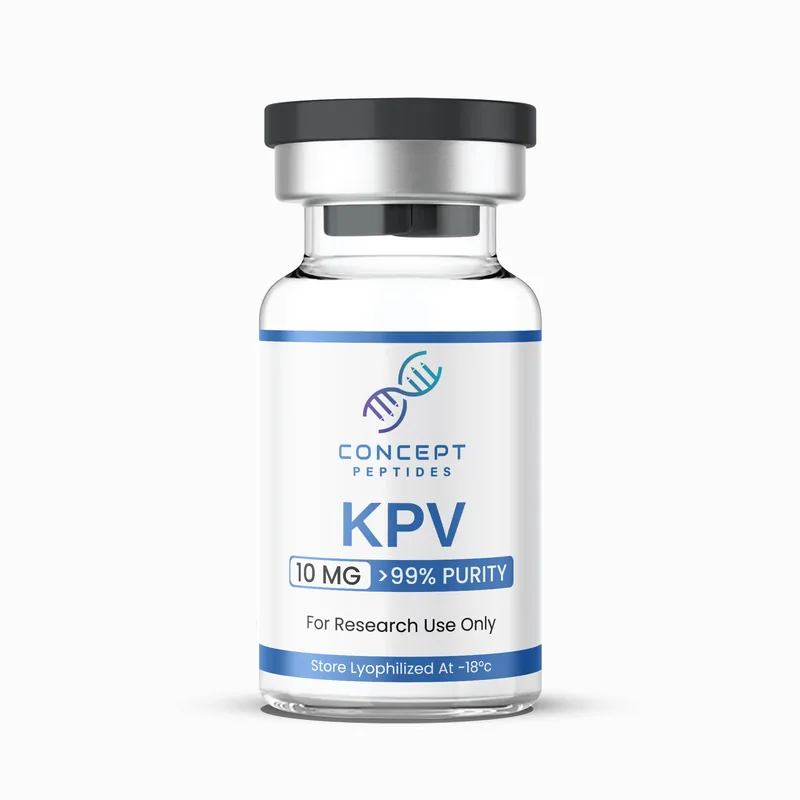
KPV is a naturally occurring tripeptide — lysine, proline, valine — derived from the C-terminal sequence of alpha-melanocyte-stimulating hormone (alpha-MSH), studied for its anti-inflammatory activity in gut barrier and skin healing research. For a deeper scientific overview of the compound's mechanism, see our KPV research overview. For researchers in Malaysia studying inflammatory signalling, intestinal barrier integrity, or dermal repair models, KPV is now accessible locally through Concept Peptides without the complications of international ordering.
Note: KPV supplied by Concept Peptides is a research-grade compound intended strictly for laboratory and preclinical research purposes. It is not for human consumption. Researchers requiring KPV for clinical or licensed medical use should approach their institutional pharmacy or a licensed pharmaceutical distributor.
What Makes KPV Different?
NF-kB Pathway Suppression
The nuclear factor kappa B (NF-kB) pathway is a central regulator of inflammatory gene expression. Research shows that KPV suppresses NF-kB activation in intestinal epithelial cells and macrophages, reducing transcription of pro-inflammatory mediators including IL-6, IL-1beta, TNF-alpha, and COX-2 — making it a compact, well-characterised tool for studying inflammatory signalling despite its small three-amino-acid size.
Melanocortin Receptor Binding
KPV interacts with melanocortin receptors, particularly MC1R and MC3R, which are expressed on immune cells, intestinal epithelial cells, and dermal fibroblasts. Binding to MC1R on macrophages is associated with a shift from pro-inflammatory (M1) toward anti-inflammatory (M2) polarisation, a mechanism of considerable interest in inflammation and wound-healing research.
Gut Barrier and Skin Healing Applications
In experimental colitis models, KPV administration has been associated with reduced histological damage scores and preserved tight junction protein expression. In dermal wound-healing models, KPV has been studied for its ability to reduce local inflammatory cytokine production while supporting fibroblast activity and collagen deposition. These combined properties are also why KPV is frequently studied alongside other repair-focused peptides — see our guide on the KLOW Blend, which pairs KPV with GHK-Cu, TB-500, and BPC-157.
How to Buy KPV in Malaysia
Local vs Overseas Sourcing
KPV research peptide sourced from overseas typically arrives in 3–5 weeks and involves customs risk. As a Malaysia-based supplier, Concept Peptides ships KPV domestically with 1–3 business day delivery and no import complications. Every product is accompanied by a third-party Certificate of Analysis confirming sequence accuracy and purity.
What Format Is It Supplied In?
Concept Peptides supplies KPV as a lyophilised (freeze-dried) powder in sealed research vials, available in a 10mg size. Lyophilisation preserves stability and extends shelf life prior to reconstitution. It is reconstituted with BAC Water prior to use. A free BAC Water vial is included with every KPV order.
Purity Verification
Every product is independently tested by a third-party laboratory and a Certificate of Analysis (COA) is available upon request, confirming the amino acid sequence, molecular weight, and purity percentage by HPLC.
Frequently Asked Questions
What is KPV used for in research?
KPV is used in preclinical and research settings to study NF-kB pathway suppression, melanocortin receptor (MC1R/MC3R) signalling, macrophage polarisation, gut barrier integrity, and skin wound healing models.
Where can I buy KPV in Malaysia?
Research-grade KPV is not sold in pharmacies or retail stores in Malaysia. Concept Peptides is a Malaysia-based supplier stocking KPV in lyophilised research-grade format, with local payment methods and domestic shipping throughout Malaysia — order via WhatsApp or through the product page directly.
Is KPV available in Malaysia?
Yes — Concept Peptides stocks KPV in lyophilised research-grade format, available for order with local payment methods and domestic shipping throughout Malaysia, strictly for research and laboratory use.
How does KPV relate to the KLOW Blend?
KLOW is a multi-peptide blend combining KPV with GHK-Cu, TB-500, and BPC-157, formulated so researchers can study combined effects on skin repair and tissue healing in a single vial. Researchers studying KPV in isolation can order it separately, or explore our dedicated guides on the KLOW Blend and where to buy KLOW in Malaysia.
How should it be stored after arrival?
Lyophilised KPV should be stored at -20°C for long-term stability. If the vial will be used within 4–6 weeks, storage at 2–8°C is acceptable. Once reconstituted with BAC water, store the solution at 2–8°C and use within 28 days. Avoid repeated freeze-thaw cycles of the reconstituted preparation.
References
- Catania A, Lonati C, Sordi A, Gatti S. "Peptide agonists of melanocortin receptors as a new generation of anti-inflammatory drugs." Annals of the New York Academy of Sciences. 2010;1195:1–10.
- Kannengiesser K, Maaser C, Heidemann J, et al. "Melanocortin-derived tripeptide KPV has anti-inflammatory potential in murine models of inflammatory bowel disease." Inflammatory Bowel Diseases. 2008;14(3):324–331.